
Real Estate Services · 6 min · 1 December 2025
Five Checks Before You Buy Land in Ghana, Especially From Abroad
Land is one of the more durable ways to hold wealth in Ghana, and one of the easier ways to lose it quietly. Five checks we run on any parcel before advising a client to proceed.
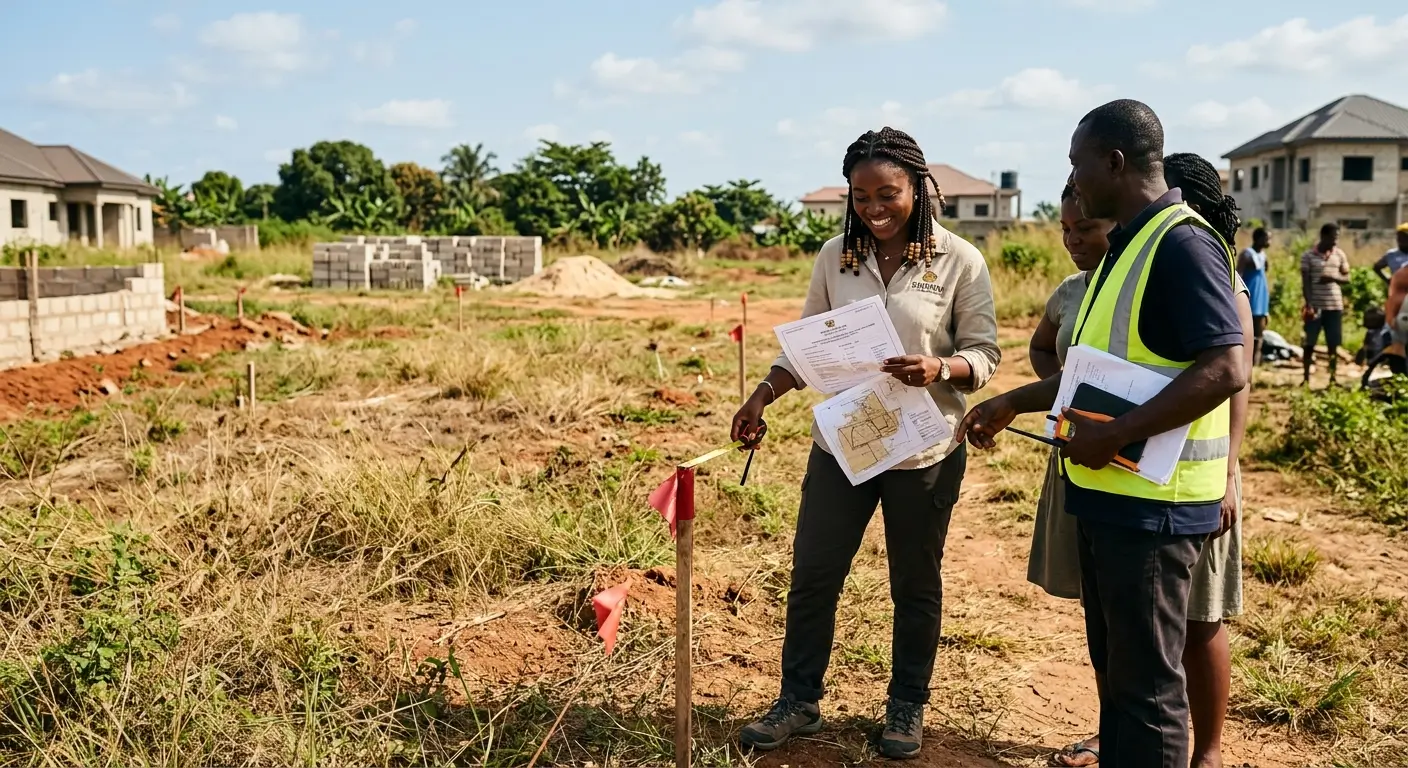
Land remains one of the more durable ways to hold wealth in Ghana. It is also one of the easier ways to lose money quietly — a bad parcel rarely announces itself before the money has changed hands, and the buyer is often two time zones away when it does.
These are the five checks we run on any parcel before we advise a client to proceed, diaspora or otherwise.
1. Title and documentation
Ownership should be provable, not just claimed. Ask for the Land Title Certificate or Deed of Assignment, a site plan with registered coordinates, and the seller’s identification matched against the land’s registered history at the Lands Commission. An unregistered plot, a family-owned parcel with no paper trail, or a promise to “register after payment” are not documentation gaps to work around — they are the transaction telling you what it is.
2. Litigation and land-guard history
A meaningful share of disputed Accra-area land carries either an active litigation history or a land-guard presence that extorts buyers and blocks development after the fact. Confirm litigation-free status before any payment moves, and ask directly about land-guard incidents on the parcel — a seller with nothing to hide answers this without hesitation. Never rely on photographs alone; a personal inspection, or a trusted representative standing on the plot, is not optional.
3. Location and growth trajectory
Cheap is not the same as good. Weigh road accessibility, proximity to the infrastructure that actually drives value — arterial roads, schools, hospitals, retail — and the zoning designation for the area. Accra’s fastest-appreciating corridors are rarely the ones already fully built out; they are the ones where the infrastructure commitment is visible but not yet fully priced in.
4. Utilities and services
A plot that looks complete on a site plan can still be unbuildable in practice. Confirm proximity to the electricity grid, a real water source — pipe-borne or a viable borehole — functioning drainage, and a road network that will actually carry construction traffic. Land already sitting inside a developing estate layout or planned community is a materially safer bet than an isolated parcel waiting for infrastructure that may or may not arrive.
5. The seller’s track record
Whether the counterparty is an individual or a company, their history is diligence too. Ask what else they have sold, whether they can produce references, whether they offer a proper sales agreement with legal support, and whether the land is currently registered in their own name — not a relative’s, not a predecessor’s.
None of these checks are exotic. What they require is time, a second set of eyes on the ground, and a willingness to walk away from a parcel that fails even one of them. For a buyer directing the purchase from London, Toronto, or New York, that second set of eyes is usually the difference between a good outcome and an expensive lesson.
Continue the conversation
If you're weighing a parcel from abroad, our real-estate advisory runs this exact checklist before any client proceeds.
Or call +233 500 903 792